Unlocking the Value Chain Between Power and Computing: BodaData Wins the “AI Infrastructure Innovation Award of the Year”
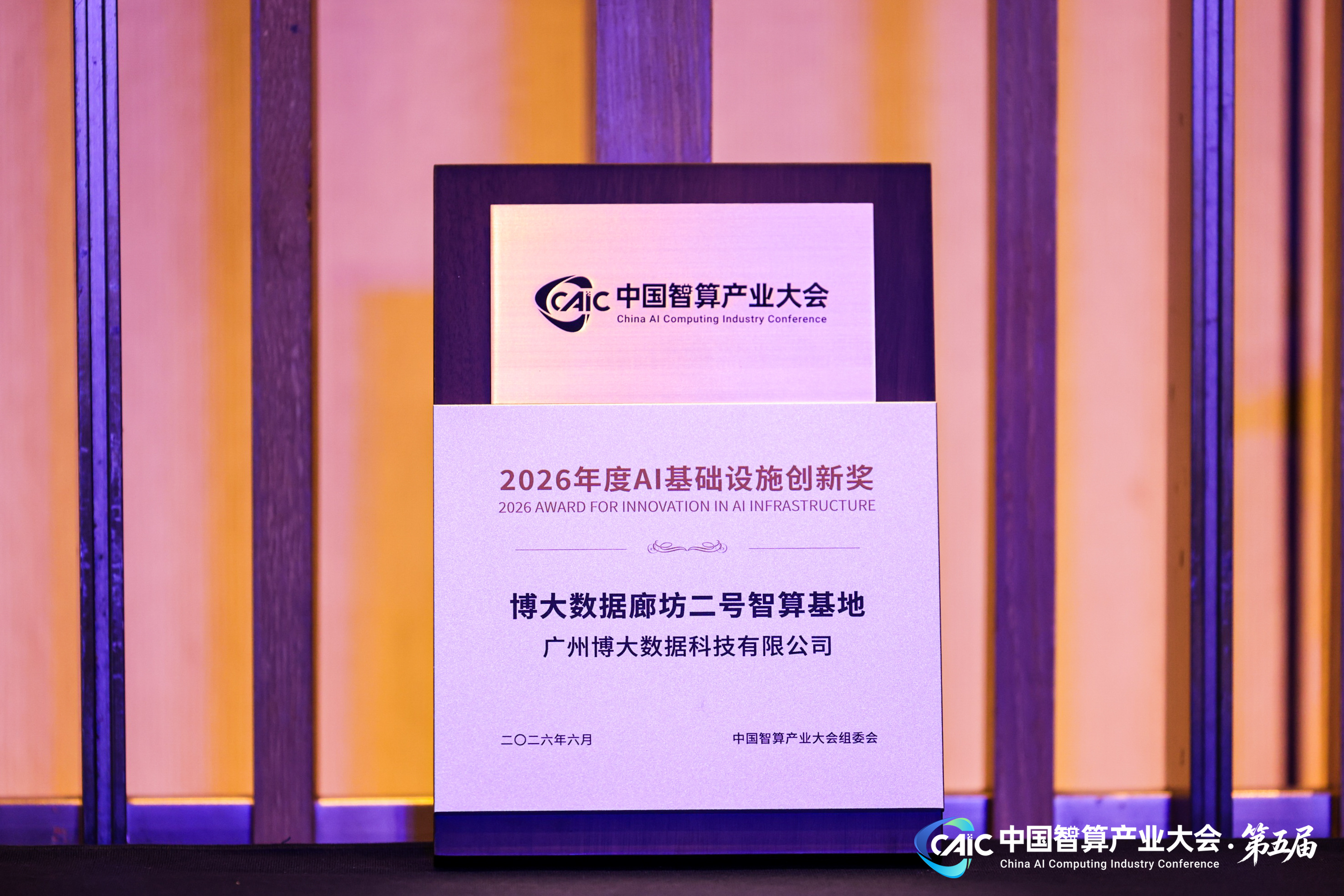
On June 30, the 2026 China Intelligent Computing Industry Ecosystem Development Annual Conference was held in Shenzhen. As an important platform for collaboration and exchange across the intelligent computing industry, this year’s conference focused on key areas including AI infrastructure, computing services, industry applications, and ecosystem collaboration. It brought together data center owners and operators, upstream and downstream companies across the intelligent computing industry, key end users, investment institutions, and other industry stakeholders to advance technological innovation, industry matchmaking, and ecosystem collaboration. At the conference, BodaData was awarded the “2026 Award for Innovation in AI Infrastructure” in recognition of its advanced power infrastructure technologies deployed at the BodaData Langfang No. 2 AIDC.
The “2026 Award for Innovation in AI Infrastructure” recognizes innovative products and solutions that provide a solid computing foundation for the AI era, with a particular focus on product performance, architectural innovation, energy efficiency, scalability, and real-world deployment capabilities. Designed to meet the growing demand for high-density computing in the AI era, the BodaData Langfang No. 2 AIDC has deployed advanced power supply solutions at scale, establishing a representative engineering model in power efficiency, system reliability, green and low-carbon operations, rapid deployment, and future evolution capability. The award recognizes BodaData’s continued innovation in the development of next-generation AIDC infrastructure and the application of critical technologies, while also demonstrating its comprehensive capabilities in integrated computing infrastructure services.
Deepening AI Infrastructure Capabilities and Strengthening the Computing Foundation for the AI Era
As AI applications continue to expand rapidly and GW-scale computing clusters are increasingly deployed, computing power has become a critical foundation for the development of the digital economy. With the growing adoption of large-model training, high-density GPU clusters, and intelligent applications across industries, demand continues to rise for high-performance computing, customized intelligent computing services, and highly efficient infrastructure. At the same time, the intelligent computing industry faces higher requirements for supply-demand alignment, technological collaboration, commercialization of innovations, and ecosystem connectivity, driving stakeholders across the value chain to further strengthen resource integration and collaborative innovation.
As a leading provider of integrated computing infrastructure services, BodaData’s core team has more than 20 years of industry operations and management experience. The company has accumulated extensive resources in general-purpose computing, intelligent computing, and edge computing, while developing strong capabilities in computing infrastructure construction, platform services, and computing operations. In response to the needs of the digital economy, BodaData is committed to building an integrated digital infrastructure platform that converges data and computing resources, providing enterprise customers with stable, efficient, and sustainable computing infrastructure.
The award-winning BodaData Langfang No. 2 AIDC is a key infrastructure project developed to address the demand for high-density computing in the AI era. The project was designed and constructed in accordance with China’s Class A data center standards and international Tier III+ standards. The facility is currently providing customized services to a leading internet customer, demonstrating BodaData’s proven capabilities in large-scale AIDC construction, engineering delivery, and supporting the operational needs of major customers.
Power Defines the Boundaries of Computing, Helping Customers Build “Token Factories”
Against the backdrop of rapidly expanding large-scale AI model training and high-density GPU clusters, the relationship between power and computing has evolved from “supporting” computing to “defining” it. Power supply efficiency determines the upper limit of computing performance, while the power architecture determines the long-term competitiveness of the underlying infrastructure.
To address challenges associated with traditional data centers, including lengthy multi-stage power conversion chains, high energy losses, and long construction cycles, the BodaData Langfang No. 2 AIDC fundamentally re-engineered the conventional power supply architecture from the ground up, based on the underlying logic of power and computing. Centered on “high-voltage direct conversion, high-efficiency integration, and modular evolution,” the project adopts an optimized power architecture designed to reduce conversion losses and improve the efficiency of power delivery to IT equipment, providing a more efficient and reliable power foundation for AI training and inference.
In terms of energy efficiency, the power architecture significantly reduces losses during power transmission and conversion, substantially improving end-to-end efficiency from the grid to the server. The project is capable of saving a significant amount of electricity annually while effectively reducing carbon emissions, providing a quantifiable approach to greener and lower-carbon AI infrastructure operations. As computing density continues to rise, efficient power utilization is not only critical to operating costs but also serves as a fundamental pillar for ensuring the long-term stable operation of large-scale computing clusters.
At the deployment level, the project adopts standardized, modular, and factory-prefabricated designs. Its core power supply systems are delivered in rack-based form, enabling plug-and-play deployment. Compared with traditional construction-based power infrastructure, this approach significantly reduces equipment and construction requirements while substantially shortening deployment cycles. It is better suited to the stringent demands of high-density AIDC environments for space utilization and rapid commissioning. This enables customers to deploy and expand computing clusters more rapidly, helping them seize first-mover advantages in AI-driven business opportunities.
As computing architectures continue to evolve, the BodaData Langfang No. 2 AIDC has proactively established a comprehensive power supply capability spanning today’s general-purpose workloads to future ultra-high-power GPUs. It can seamlessly support next-generation GPUs and high-density liquid-cooling deployments. This technical architecture not only meets the needs of current AI training scenarios but also reserves ample headroom for higher-power AI workloads in the future, ensuring that customers’ investments in computing infrastructure remain viable over the long term.
By deeply integrating the value of power with the demands of computing, BodaData has not only established a highly representative technical model through the development of advanced AIDC facilities, but has also committed itself to helping customers build efficient, stable, and continuously evolving “Token Factories.” By making computing production as efficient, reliable, and sustainable as industrial manufacturing, BodaData provides sustained momentum for business innovation in the AI era.
推荐资讯
more- 博大数据亮相2026香港金融科技周,以智算底座作答“AI+金融”
- 以“AI”为桥,菲律宾一号智算基地共赴中国-东盟魅力之约
- 博大数据亮相2026云栖大会:以定制化智算服务承接AI规模化需求
- 跨界融合共创,AI+产业创新实践之旅走进博大数据前海一号智算基地
- 聚焦算网融合新趋势,博大数据参与2026算力网发展大会
- 博大数据参加2026中国算力大会:让算力更好支撑智能,让智能真正转化为生产力
- 聚焦数智新未来,博大数据亮相第十六届智慧城市与智能经济博览会
- 《算力中心服务商分析报告(2026年)》发布 博大数据多维能力获行业认可
- 锚定三个价值、推动六大变革、构筑十大能力,博大数据加速融合算力布局
- 锚定三个价值、推动六大变革、构筑十大能力,博大数据加速融合算力布局